Employee benefits
Employee snack credit: the low-cost break room incentive people actually use
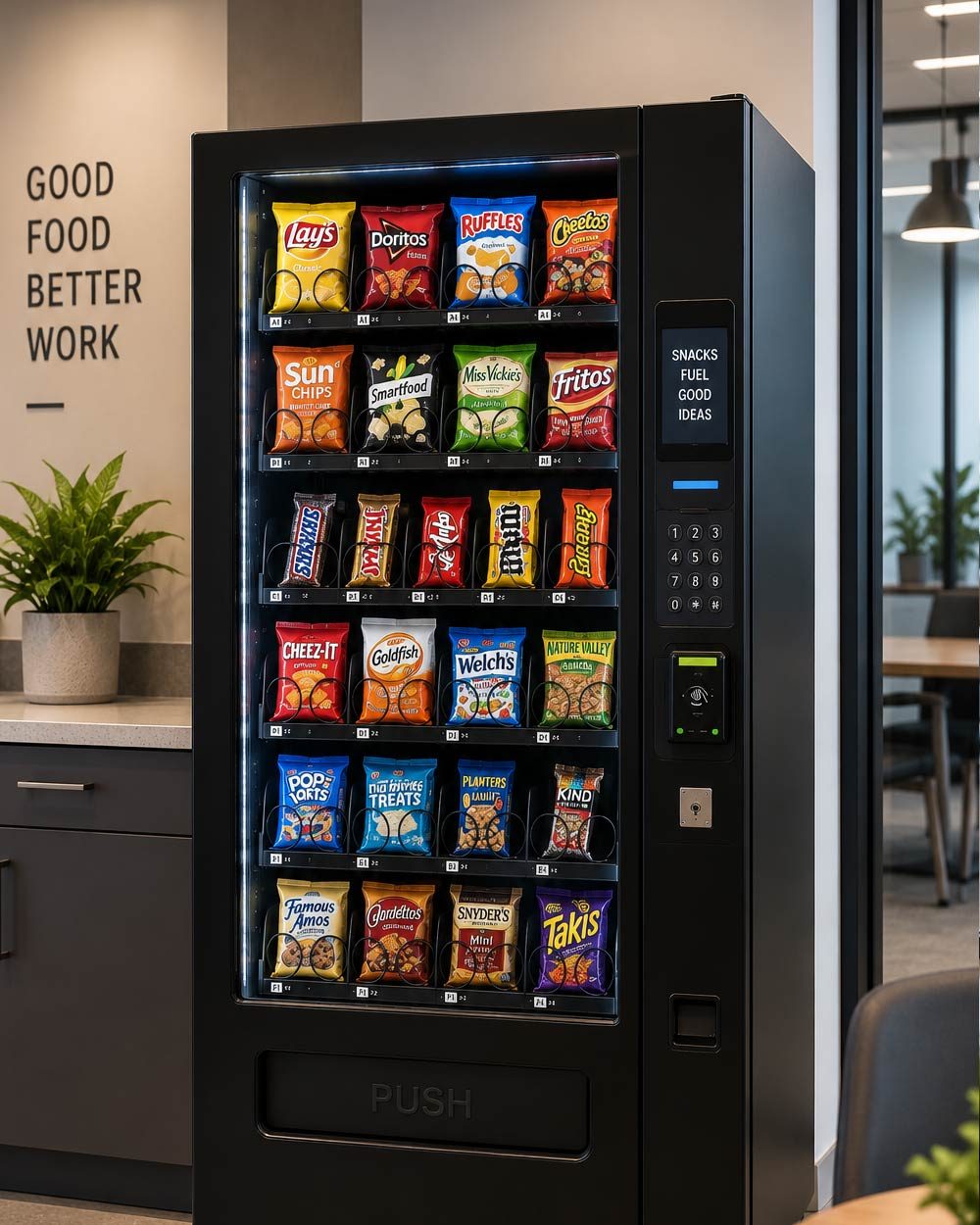
If you're a manager, owner, or HR lead hunting for employee incentive ideas that don't require a compensation review, here's one that rarely makes the list: give every employee a set dollar amount each week or month to spend in the break room, and put a vending machine where they can spend it.
It sounds almost too small to matter. In practice it's one of the few perks that gets used by nearly everyone on the payroll, every week, without a rollout committee or a new software vendor.
Why small and frequent beats big and occasional
A $500 year-end bonus is absorbed into a car repair and forgotten by February. Ten dollars a week, on the other hand, gets noticed roughly fifty times a year — every time someone taps their badge at 2 p.m. and doesn't pay for their own coffee or chips.
That's the whole mechanic. People don't remember the size of a benefit nearly as well as they remember how often they touch it. Recognition that shows up on a predictable cadence reads as "this place looks after us." A once-a-year payout, however generous, reads as accounting.
A snack credit also has something most perks don't: a physical location. The gym reimbursement nobody claims lives in a PDF. The break room machine is in the room where your team already spends its fifteen minutes.
What an employee snack credit actually costs
This is usually the part that surprises people. The numbers per employee, per month:
- $5 per week — about $22/month per employee. Covers roughly two items a week. Reads as a genuine gesture.
- $10 per week — about $43/month per employee. Covers a daily drink or an afternoon snack. The most common starting point.
- $20 per week — about $87/month per employee. Starts to feel like a real benefit for people who eat on site every shift.
Run that across a 40-person operation at the $10 tier and you're looking at roughly $1,730 a month, or about $20,800 a year. Now compare it to the cost of replacing a single hourly employee — commonly estimated at a third to a half of annual salary once you count recruiting, onboarding, and the productivity gap while the seat is empty. One avoided turnover event can pay for a meaningful share of the program.
And unlike a wage increase, a snack credit is reversible, scalable, and easy to pilot on one shift before you commit to the whole building.
How the money actually moves
The mechanics matter more than the idea, because this is where most well-meaning programs stall. There are a handful of standard ways employers fund break room credit, and they differ in cost, tracking, and how much admin lands on your desk:
- Employer-funded accounts on a cashless reader. Employees tap a badge, card, or phone, and a monthly allowance draws down automatically. The cleanest employee experience, and the best reporting.
- Prepaid cards issued monthly or quarterly. Low-tech and immediate. Easy to hand out at a shift meeting, harder to audit.
- Free-vend allowances. The machine is set to dispense at no charge on certain days, during certain hours, or on certain selections — the employer settles up with the operator. Popular for safety milestones, inventory weekends, and overtime shifts.
- Tokens or vend coupons. The simplest version of all. A manager hands out a token for a job well done and the recognition happens in the moment.
Which of these is available depends on the machine and the payment hardware in it, so the practical first step is to tell your vending provider the structure you want — a flat weekly allowance, a milestone reward, a free-vend shift — and have them confirm what the equipment supports before you announce anything. One quick note: how a subsidy like this is treated for payroll and tax purposes varies with how it's structured, so loop in your CPA or payroll provider before launch.
Why snacks work better than a gift card of the same value
A $40 gift card gets spent somewhere you'll never see, by one person, once. Forty dollars of break room credit gets spent in the room where your team eats, in front of coworkers, across the whole month. Three things follow from that:
- It's visible. Perks nobody sees don't build goodwill. This one is used in public.
- It's communal. A stocked break room pulls people out of their cars and away from their desks, which is where the informal part of a team actually gets built.
- It's habitual. The benefit re-earns attention every week instead of decaying after one use.
There's a practical angle too. A drink and a snack on site is a break that takes twelve minutes instead of a drive that takes thirty-five. We've written more about that in reducing workplace downtime with vending.
Where this lands hardest
A snack credit isn't equally valuable everywhere. It's worth the most where leaving the building mid-shift is impractical:
- Manufacturing and production floors — fixed breaks, no time to go anywhere
- Warehouses and distribution centers — often sited well away from any food options
- Second and third shift operations — everything nearby is closed, and night crews notice being an afterthought more than anyone
- Clinics, care facilities, and call centers — coverage requirements make stepping out difficult
- Offices in light industrial parks — technically free to leave, realistically a twenty-minute round trip
Across Livingston and Oakland County, that describes a lot of buildings: plants and shops in Howell, Brighton, Fenton, and Hartland where the closest gas station is a drive, not a walk.
How to roll it out in a week
- Pick the amount and the cadence. Weekly amounts feel more generous than the same money delivered monthly. Start at $10 per week if you're unsure.
- Decide whether it's universal or earned. Universal is simpler and signals "everyone here matters." Tying it to safety streaks, perfect attendance, or peak-season weeks turns the same dollars into recognition. Plenty of employers run both: a small baseline for everyone, extra loaded for milestones.
- Confirm the machine can do it. Product mix and payment setup both matter. If half your crew works nights, ask about stocking for night-shift preferences too.
- Announce it like a benefit, not a memo. Say the amount out loud, in a shift meeting, and put a sign on the machine. An unannounced perk is a wasted perk.
- Review at 60 days. Look at usage, ask two questions in your next pulse survey, and adjust the amount or the product mix.
The mistakes that sink these programs
- An unreliable machine. A credit program on a machine that jams, runs empty, or eats money converts a perk into a weekly complaint. Service consistency isn't a detail here — it's the whole thing.
- Fuzzy rules. If people aren't sure whether the credit rolls over, what it covers, or when it resets, most of them just won't use it.
- A silent launch. Employees who don't know the credit exists give you zero goodwill for the money.
- Empty at 2 p.m. Subsidized machines sell faster than unsubsidized ones. Restock frequency needs to account for that from day one.
- Treating it as a substitute for pay. It isn't one. It's a supplement that makes an existing workday better. Presented as a replacement for a raise, it will land badly.
How to tell whether it's working
You don't need an analytics platform. Three signals are usually enough: machine usage data from your provider, a single line item in your next engagement survey ("the break room is well stocked" — agree/disagree), and whether the perk starts coming up on its own in exit interviews and stay conversations. If you're building a broader retention case, our guide on improving retention without raising payroll covers where this fits alongside scheduling and recognition.
The short version
A break room credit is one of the smallest line items you can add to a benefits conversation and one of the few that every employee touches every week. The machine costs you nothing to install through Route One Vending — we cover equipment, stocking, and service. If you want to fund a weekly or monthly employee credit on top of it, that's a decision you can pilot on one shift, measure in 60 days, and scale or stop at will.
Most of the managers who end up running one of these weren't shopping for a vending machine. They were looking for something to do about employee satisfaction that didn't require a budget cycle.
Frequently asked questions
How much should an employee snack credit be per week?
Most employers land between $5 and $20 per employee per week. $5 a week covers roughly two items and reads as a nice gesture. $10 a week covers a daily drink or an afternoon snack and is the most common starting point. $20 a week starts to feel like a real benefit for shift workers who eat on site.
Is a snack credit cheaper than a raise or a bonus?
Dramatically. A $10 per week credit is about $43 per employee per month, or roughly $520 a year. For a 40-person shop that's around $20,800 annually — and unlike a raise, it's visible every single day and can be paused, scaled, or tied to safety and attendance milestones.
How do employees actually spend the credit at the machine?
It depends on how the machine is configured. Common setups include employer-funded accounts tied to a badge or phone on a cashless reader, prepaid cards handed out monthly, a free-vend allowance on selected days or items, and simple token or coupon programs. Ask your provider which of these your equipment supports before you pick one.
Do we have to buy the vending machine to offer a snack credit?
No. Route One Vending installs, stocks, and services machines at no cost to the business. If you want to add an employee credit on top, you're only funding the subsidy you choose — not the equipment or the service.
What kinds of workplaces get the most out of this?
Workplaces where people can't easily leave during a shift: manufacturing floors, warehouses, distribution centers, clinics, call centers, and any site running second or third shift or sitting more than a few minutes from food.
Related reading
Tell us the credit structure you want and we'll tell you what it takes to run it.
Get a Free Machine